Anyone who wants to understand a country usually starts by gathering information. History, politics, religion, economics, everyday culture, social rules. One reads about concepts that are supposed to explain why people behave the way they do, and gradually an image emerges that seems increasingly complete. With Japan in particular, this can happen surprisingly quickly. Harmony, duty, group, politeness, tradition, shame, discipline, Zen, modernity – a handful of words is enough, and suddenly an entire society appears to have been explained, a society whose history spans centuries and in which more than one hundred million people live.
Perhaps the problem begins precisely there.
Because the more complete an explanation appears, the greater the danger that it no longer concerns people at all, but only our idea of them.
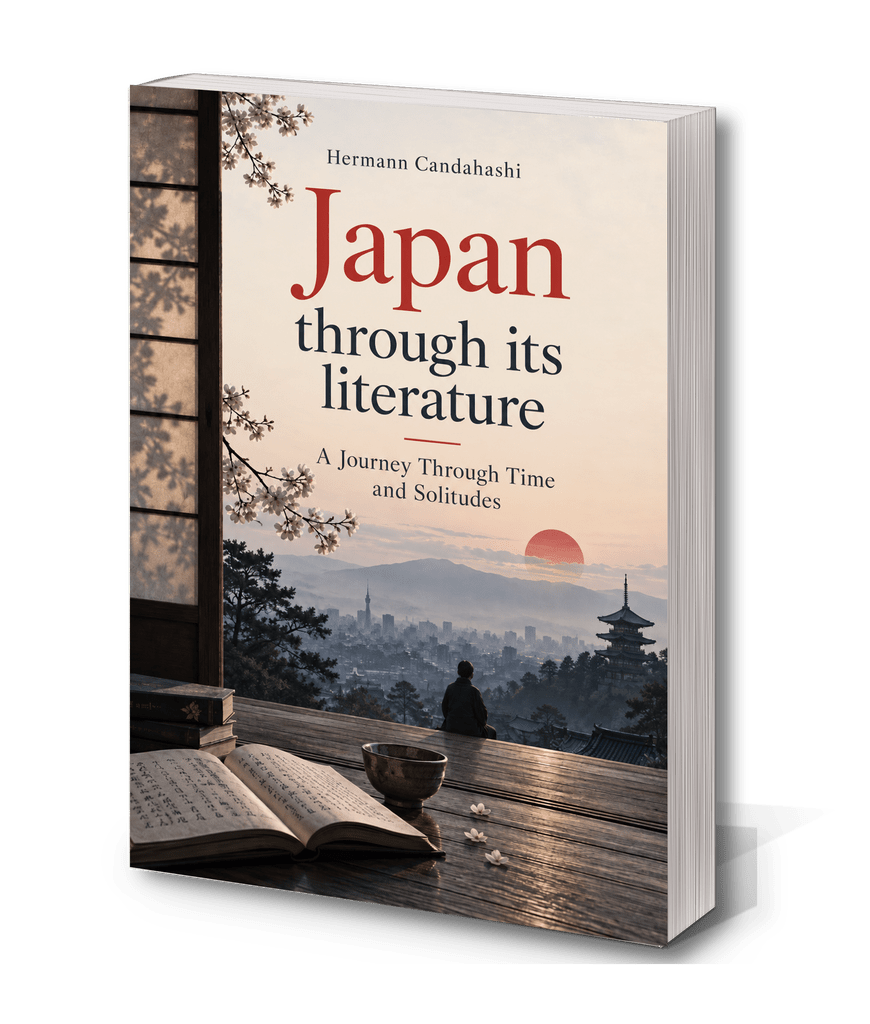
Understanding Japan Through Its Literature – A Journey Through Time and Solitudes grew out of an attempt to reverse this process. The book does not seek to explain Japan first and then use literary works as evidence. It takes the opposite route. Literature comes first. The contradictions are allowed to remain. And the reader has to accept that a society does not immediately fit into a formula.
That distance is not a refusal to understand.
It is a condition for understanding.
What Does It Mean to Understand Japan Through Its Literature?
The obvious answer would be: one reads Japanese writers and thereby learns something about Japanese history and culture. That is not wrong, but it does not go very far.
Literature is not ethnographic evidence. A novel does not explain a nation, a poem does not prove a mentality, and a literary character is not a typical representative of a society. To read literature that way is to turn art into a particularly elegant form of statistics.
I am interested in something else.
Literature does not necessarily show what a society is like. It shows what a society has had to think about. Which conflicts became tellable. Which longings returned. Which roles were assigned to people, and what happened when someone could no longer or no longer wished to fulfil them.
That is a crucial difference.
A society may claim that family is important while its literature tells of people who become lonely within the family. It may declare harmony an ideal while its writers show what silence costs. It may place great value on social belonging while at the same time producing characters who can no longer find a place precisely because they do not fit the available forms of belonging.
That is where literature becomes interesting.
Not because it confirms a society’s self-image, but because it damages it.
A Distant Gaze Is Not a Cold Gaze
The word distance can easily be misunderstood. It sounds like detachment, like a position from which one observes the subject from outside and refuses to be affected by it.
What I mean is the opposite.
Distance means not mistaking the first impression for knowledge.
Someone who admires Japan can be just as mistaken as someone who rejects it. The romantic Japan and the supposedly incomprehensible Japan are siblings. Both turn the country into an exception. On one side stand cherry blossoms, aesthetics, Zen, centuries-old tradition, and perfect politeness; on the other, performance pressure, loneliness, overwork, social harshness, and supposedly rigid rules.
Both images may contain fragments of truth.
That is precisely what makes them dangerous.
A cliché does not need to be completely false. It is enough for it to take something real and turn it into something final.
The distant gaze therefore does not try to create closeness as quickly as possible. It first asks which expectations we ourselves bring with us. What do we see because it is actually there, and what do we merely recognize because we have already heard it about Japan?
Perhaps this is a basic condition of every serious attempt to approach another society.
At some point, we have to become suspicious of our own understanding.
Why the Book Is Written as Essays
Understanding Japan Through Its Literature is deliberately essayistic in form.
The essay is particularly suited to this task because it does not have to pretend to offer a complete system. It can follow a trace, lose it, pick it up again, and end at a point where the question has become more precise without necessarily being fully answered.
An encyclopedia has to organize. A textbook has to structure. A scholarly study has to define its subject and keep its concepts as stable as possible.
The essay is allowed to be more suspicious.
It can use a concept and then, a few pages later, discover that the concept has become too crude for the people who have entered the text in the meantime.
That matters for this book.
Because terms such as tradition, individuality, community, family, or solitude initially possess a comforting clarity. Then a person appears. He loves the order under which he suffers. He wants to leave and at the same time fears that he may no longer be able to return. He seeks closeness and protects himself through distance. Suddenly the concept is no longer enough.
That is not a weakness of the inquiry.
It is the moment when the inquiry becomes more precise.
The Language Must Be Able to Endure Contradiction
This attitude also determines the language of the book.
It should not explain before it has looked. It may sharpen a thought, but it should not bury the subject beneath the cleverness of the formulation. Above all, it should not constantly tell the reader what lesson to draw from a passage.
I am interested in sentences that follow a thought far enough for that thought to begin resisting its own simplicity.
Because societies are contradictory, and a language that seeks to describe them should not constantly eliminate those contradictions.
A family can offer protection and make a person unfree.
A social role can restrict someone and at the same time give that person a place.
Tradition can be a burden and a form of memory.
Modernization can create freedom and produce new forms of loneliness.
None of these statements requires us to decide afterwards which half is the correct one.
Both can be true.
Perhaps that is one of the differences between an essay and a verdict. A verdict wants to close the matter. An essay is allowed to remain longer with the difficulty.
Why Solitude?
The subtitle of the book is A Journey Through Time and Solitudes.
The plural matters.
There is no such thing as the Japanese solitude.
The very idea would be problematic. It would turn very different historical experiences into a national characteristic. Solitude is not a cultural gene, nor is it a specifically Japanese condition.
But it is exceptionally useful for making social change visible.
Because people do not become lonely only when other people are absent.
One can be lonely within a family, within a marriage, within a community, within a company, even within a social role that functions perfectly.
Perhaps that form is the more interesting one.
The person belongs and still does not reach the others.
Solitude therefore becomes a way of seeing. It reveals the distance between social order and personal experience.
What happens to a person when the role that was supposed to provide belonging suddenly no longer holds? What happens when social expectations have become so self-evident that no one needs to state them openly? When does consideration become self-denial? When does independence become liberation, and when does it become merely another form of being alone?
These questions do not belong to Japan alone.
But Japanese literature asks them under Japanese historical conditions.
And that is precisely what makes them interesting to us.
Literature as an Antidote to the Fast Japan
Japan is one of those countries about which people in the West often make remarkably confident statements.
Perhaps this has to do with the country’s enormous cultural visibility. Anime and manga, Kurosawa and Murakami, samurai and Zen, sushi, Nintendo, Toyota, Kyoto, Tokyo, and Mount Fuji have created a dense network of associations.
The problem is not that these things are untrue.
The problem begins when visibility is confused with knowledge.
Literature can disturb that certainty.
It leads us back from the concept to the individual person.
“The Japanese woman” becomes a particular woman with interests and contradictions of her own. “The Japanese family” becomes parents and children who love one another and still do not know how to live together. “Japanese society” suddenly becomes someone who gets up in the morning and discovers that the order within which their life had once been understandable is no longer the same.
As soon as people appear, large cultural explanations become uncomfortable.
That is good.
Why Approaching Requires Distance
At first it sounds paradoxical: in order to come closer to a country, we should keep our distance.
But closeness is not automatically understanding.
One can become fascinated by a culture and, precisely because of that fascination, stop looking carefully. Admiration creates its own blind spots. It wants to preserve the object that fascinates it.
Distance therefore means not immediately loving or rejecting what appears foreign.
It means allowing an observation to remain unresolved for a little longer.
Perhaps something initially appears typically Japanese. Then we discover historical reasons for it. After that we notice that the same experience exists elsewhere, but has taken a different form there.
And suddenly the question changes.
No longer: Why are Japanese people like this?
But rather: Under what conditions do people behave this way?
That is a small linguistic difference and a major intellectual one.
The first question searches for a cultural trait.
The second searches for history, society, and people.
Understanding Japan Does Not Mean Making Japan Simpler
Perhaps this is the most important expectation I associate with the book.
Anyone who reads Understanding Japan Through Its Literature should not be able to explain Japan in ten sentences by the end.
If that were possible, something would probably have gone wrong.
Understanding does not mean that the subject becomes simpler. Sometimes it means exactly the opposite. The concepts become less secure, the contradictions more visible, simple answers less attractive.
One does not know less afterwards.
One knows in a more complicated way.
And perhaps that is the more serious form of knowledge.
Japan does not have to remain mysterious in order to be interesting. But neither does it have to fit completely into our categories for us to come closer to it.
The book moves between these two temptations.
It seeks neither the exotic Japan nor a Japan that is, in the end, simply like every other society. Both would diminish the subject.
Japan has its own history, its own social developments, its own cultural forms, and its own literary traditions. At the same time, people live there whose experiences can sometimes come closer to us than the distance would suggest.
Perhaps that is the moment these essays are waiting for.
At first, we read about Japan.
Then we read about a person.
And at some point we realize that a question we thought was Japanese has long since entered the space between ourselves and the text.
From that moment on, the journey changes.
We are no longer only looking at Japan.
Japan looks back.