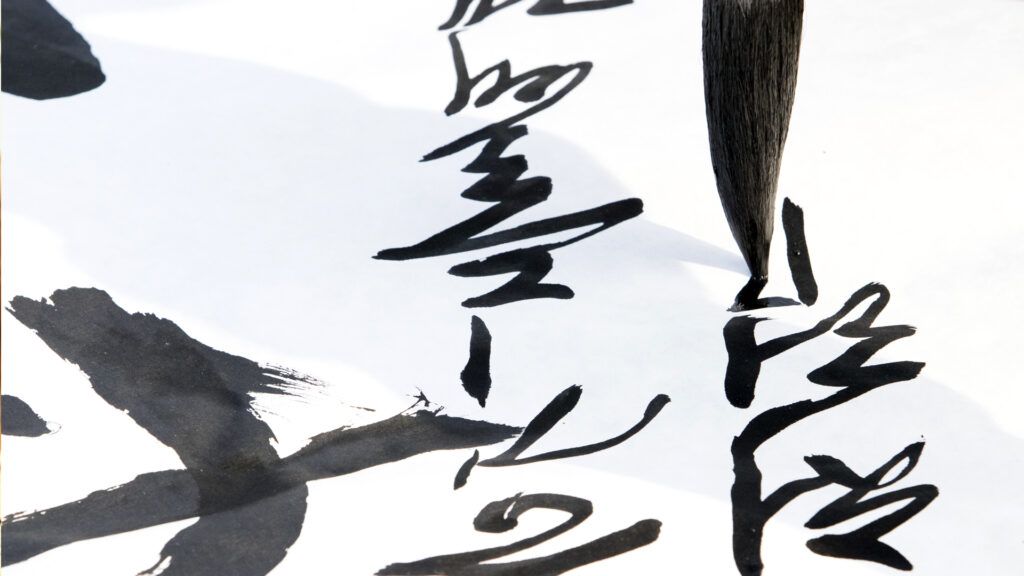
There is something peculiar about Japanese calligraphy that continues to fascinate me. A person picks up a brush, dips it into black ink, and lowers it onto a sheet of white paper. A seemingly simple action, promising neither great drama nor extraordinary significance. And yet, at that very moment, something irreversible takes place. The instant the brush touches the paper, it leaves a trace. That trace cannot be withdrawn, erased, or transformed afterward into something else. One can take another sheet and begin again. But what has already been written remains exactly what it is.
Perhaps this is where we encounter a fundamental difference between calligraphy and our modern understanding of writing. We have become accustomed to the idea that almost everything can be corrected. A wrong word is deleted, an unsuccessful sentence rearranged, an awkward expression improved. Our texts emerge through countless revisions, their earlier forms disappearing without leaving a trace.
The Japanese calligrapher does not enjoy this luxury. His hand makes its decision in the moment of movement. And with every movement, he assumes responsibility for what becomes visible.
At first, this may seem like a purely technical distinction. In fact, it touches on a philosophical question that reaches far beyond the art of writing: How much control does a human being truly possess over what he creates? And how does he come to terms with the fact that some things in life cannot be undone?
In Japan, calligraphy is known as Shodō, the Way of Writing. That small word, way, deserves our attention. It does not describe a mere technique whose mastery can eventually be declared complete. A way implies movement, practice, occasional failure, and the willingness to confront one’s own limitations again and again.
Here we encounter a way of thinking that has also shaped other traditional Japanese arts. It is not only the finished work that matters. The process through which it comes into being carries significance of its own.
A calligrapher may spend years writing the same characters over and over. He learns to guide the brush, control its movement, vary the pressure, and distribute the ink across the paper until individual strokes become a coherent whole. What may appear to an outsider as endless repetition gradually transforms the relationship between body, attention, and action.
Yet this is precisely where a contradiction arises that I find particularly intriguing.
How can the strict observance of rules lead to personal freedom?
We generally understand freedom as the ability to make our own decisions. Rules, by contrast, seem to restrict us. In calligraphy, however, this opposition becomes less clear. Someone who cannot control a brush may be free to make any movement he pleases. But he can hardly determine what effect that movement will produce. Only acquired skill opens up possibilities that previously lay beyond his reach.
Freedom does not necessarily emerge through the abolition of form. Sometimes it becomes possible only through the mastery of form.
Yet it would be far too easy to turn this observation into a general justification for discipline. In Japan, too, obedience is not automatically a virtue, nor is technical perfection proof of intellectual independence. A person may master every rule of his art and still have nothing of his own to say. His writing may be flawless without revealing anything of his individuality.
This is the curious limitation of every educational tradition that places great emphasis on imitation. It can pass on skills, but it cannot guarantee that those skills will eventually give rise to an individual voice.
Perhaps true artistry begins only when the student no longer tries to reproduce the hand of his teacher.
The relationship between calligraphy and Zen Buddhism lends this question another dimension. In Zen, direct experience occupies a special place. Reality is not to be understood through concepts and intellectual explanations alone. The way a person acts may itself express his relationship with the world.
The brushstroke thus becomes something more than a simple line.
While the hand is writing, the person must be present. He cannot simultaneously judge the beauty of the finished work, regret an unsuccessful beginning, and continue the next stroke without interruption. His attention is claimed by an action that cannot be paused.
In this context, we encounter the idea of a mind that is no longer imprisoned by endless deliberation and conscious self-monitoring. Zen speaks of Mushin, a state in which action is no longer obstructed by constant reflection upon itself.
This does not mean thoughtlessness. Rather, it suggests a quality of attention that does not continually attempt to observe itself.
An experienced musician may recognize something similar. As long as he must consciously think about the position of his fingers for every note, his playing remains laborious. Eventually, however, the music itself can become more important than the deliberate control of each individual movement.
The calligrapher’s hand, too, must learn to act without constantly having to reassure itself of its own abilities.
What interests me here is not so much the idea of perfect inner tranquility. I tend to distrust such tranquility whenever it is elevated into a universally binding ideal of life. Far more interesting is the possibility that, for a brief moment, a human being might cease to make himself the center of his own attention.
Perhaps this is a form of freedom we barely recognize anymore.
We live in a world in which people are increasingly encouraged to observe, evaluate, and improve themselves. Even relaxation becomes a project whose success should ideally be measurable. Concentration is supposed to make us more productive, calmness more efficient, mindfulness better equipped to manage everyday life.
Calligraphy can certainly be absorbed into this cycle. Its exercises can be marketed as methods for improving concentration, and their results can be measured and compared. Yet doing so may cause us to lose sight of precisely what gives the practice its philosophical significance.
Not every activity needs to demonstrate a benefit beyond itself.
Another thought occupies me whenever I look at Japanese calligraphy. It is not only the black lines that determine the effect of a composition. The paper that remains visible between them is equally important.
In Japanese aesthetics, we encounter the concept of Ma. It does not simply mean emptiness, but rather the consciously perceived interval or space between things, whether in architecture, music, theater, or the visual arts.
A pause can alter the meaning of a piece of music. The distance between two objects changes their relationship. And on a sheet of calligraphy, the unmarked space may contribute as much to the composition as the ink itself.
This leads us toward an understanding of beauty that is not determined by how much is made visible.
It is a remarkable idea in an age inclined to fill every available space and end every silence as quickly as possible. We speak, write, and publish as though every gap must immediately be closed.
But the absence of something is not always a deficiency.
Sometimes a thought acquires its true force through what remains unspoken.
Anyone who spends considerable time studying Japanese culture must nevertheless be careful not to turn such observations into a convenient image of an inherently quiet, modest, and harmonious people. Japanese history is no stranger to struggles for power, social constraints, or human vanity, any more than the history of any other nation.
Calligraphy, too, has never been exclusively a peaceful occupation detached from social interests.
Its foundations reached Japan from China, together with religious texts, political ideas, and cultural practices that were initially closely associated with education and social rank. The ability to write beautifully could signify authority. Those who mastered writing possessed opportunities denied to others.
The beauty of a written character was therefore not always innocent.
At the Japanese imperial court, the elegance of one’s handwriting could influence how a person was perceived. Letters were more than simple messages. Their outward appearance revealed taste, education, and social standing. The art of writing thus belonged to the subtle mechanisms through which society distinguished one person from another.
All the more interesting, then, is the development of the Japanese Kana syllabaries, which gained particular literary importance during the Heian period. In a society whose official scholarship was strongly shaped by Chinese writing traditions, women within the courtly world found their own literary possibilities through the use of Japanese script.
From this emerged works of astonishing originality. Murasaki Shikibu’s The Tale of Genji is merely the best-known example.
Of course, this did not mean that the social restrictions imposed upon women suddenly disappeared. Yet within an existing order, a space had opened in which something could develop that the order itself did not fully control.
Perhaps this is one of the most fascinating qualities of cultural traditions. They are created to preserve something, yet occasionally give rise to precisely what transcends their original boundaries.
Calligraphy itself has never been entirely confined to predetermined forms. Some works by Zen monks, in particular, possess an immediacy that has little in common with the immaculate elegance of courtly calligraphy. Their characters can appear impetuous, almost defiant. The movement remains visible, sometimes even the physical exertion from which it emerged.
Here the art of writing touches upon another concept of Japanese aesthetics: the awareness of impermanence.
In Buddhism, Mujō describes the impermanence of all things. Nothing remains forever in the state in which we find it. Whatever comes into being changes. Whatever lives eventually passes away.
Calligraphy can make this idea tangible in a peculiar way. The brushstroke preserves a movement that has already vanished. What we see on the paper is not the action itself, but what it has left behind.
Something that happened during a brief moment remains as a trace.
Yet the paper itself will age, the ink may fade, and the work may be damaged or destroyed. Its apparent permanence differs only in scale from the fleeting movement that brought it into existence.
I find something both comforting and unsettling in this.
We like to think of our work as something that will outlast us. The writer hopes his books will continue to be read. The artist wants his paintings to endure. Even our everyday decisions are often guided by the desire to create something lasting.
Calligraphy makes no such promise.
At first, it asks only that a movement be carried out with as much attention and determination as a person can summon in that particular moment.
Naturally, this should not become a romantic glorification of mistakes. Not every blurred stroke carries some deeper meaning. Sometimes things go wrong simply because the hand was uncertain or concentration faltered. A Japanese calligrapher has no obligation to transform every irregularity into a philosophical revelation.
This distinction seems particularly important to me.
Accepting human imperfection is not the same as celebrating it.
And perhaps the real challenge lies in learning both: to take one’s work seriously enough to perform it carefully, while not taking oneself so seriously that every imperfection becomes a personal defeat.
Today, when most of our writing takes place on screens, this ancient art acquires an additional significance. Our hands touch keyboards and glass surfaces while the characters that appear are rendered by machines in the same standardized forms. The individual movement disappears from the visible result.
The brush, by contrast, reveals something of the person who holds it. Not necessarily his character, as certain traditional ideas might suggest. Human beings are far too contradictory, and handwriting would be a far too unreliable witness.
But it preserves something of his presence.
The pressure of his hand. The speed of a movement. A brief hesitation before changing direction. Perhaps even the determination with which a stroke was carried through to its end.
These are not great truths hidden within the ink. And yet they touch upon a question that continues to accompany me whenever I explore Japanese culture.
How can a person discover his own identity within inherited forms without surrendering entirely to them?
Calligraphy offers no final answer. It merely reveals that discipline and freedom need not always be opposites, that beauty can exist without perfection, and that an expression may acquire significance precisely because it is impermanent.
Perhaps, then, we do not need to transform every Japanese work of art into a universal lesson about life.
Sometimes it is enough to look more closely.
At the black ink, the white paper, and the trace left by a human hand.
And at that almost imperceptible moment when a movement learned through years of practice becomes a decision entirely one’s own.