
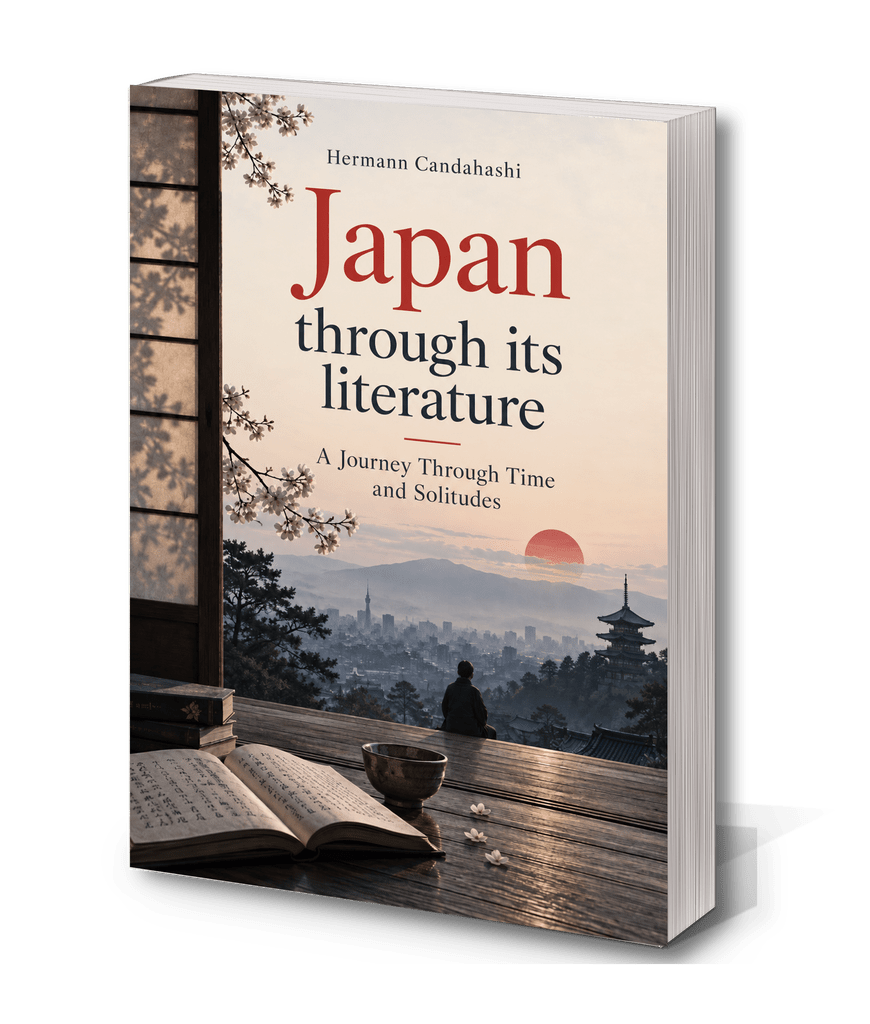
A Journey Through Time and Solitudes
Japan is often explained through what can be seen. Through temples and technology, politeness and hierarchy, cherry blossoms, working life, and that particular form of social discipline which, depending on the observer, may appear admirable or unsettling. One can learn a great deal about Japan in this way. Yet one does not necessarily encounter the people who have lived in this country, who followed its rules or suffered under them, who sought closeness and kept their distance, who adapted, resisted, disappeared.
Literature can bring these people back.
Understanding Japan Through Its Literature – A Journey Through Time and Solitudes is therefore neither a history of Japanese literature nor an academic guide through a canon of great names. The book uses literature as a way into a society that has changed over nearly a thousand years, and whose transformations become most visible precisely where history turns private: in a room, a marriage, a journey, a letter, a relationship between parents and children, or in that peculiar experience of living among other people and still never fully reaching them.
At the heart of the book are ten essays and ten different forms of solitude. They lead from Murasaki Shikibu and Kamo no Chōmei through Bashō, Natsume Sōseki and Higuchi Ichiyō to Dazai, Kawabata, Abe, Murakami and Sayaka Murata. In this way, the book moves through very different periods without constructing a neat, linear story of progress from them. The Japan of the imperial court does not simply disappear so that modern Tokyo can eventually take its place. Societies do not behave so tidily. The past remains present in expectations, gestures, roles, and ideas about what a successful life should look like, even when the conditions under which those ideas arose have long since changed.
For this very reason, solitude here is more than a private feeling.
It can arise because a person is excluded, but just as easily because they belong. Because a role offers stability while at the same time preventing someone from being seen outside that role. Because closeness is demanded where distance would be necessary, or because a society defines so precisely what relationships should look like that almost no space remains for what was not planned.
Literature has one decisive advantage over social explanation: it does not have to resolve the contradiction.
A person can love their family and still want to escape from it. They can long for freedom and miss the old order once it has disappeared. A woman can resist the expectations of her time and nevertheless remain shaped by them. A man can live in the middle of a city of millions and discover that the crowd does not reduce his loneliness but intensifies it. None of these experiences can be explained by a phrase such as “the Japanese mentality” without losing precisely what makes them interesting.
The book therefore does not search for a hidden cultural formula.
Instead, it asks what people were able to make of their lives under particular historical conditions and what remained denied to them. How does solitude change when a society changes? What happens to the individual when family, work, gender, community, or social rank are renegotiated? And why do we encounter experiences in texts separated by centuries that sometimes seem closer to one another than the worlds in which they were written would suggest?
The aim is not to describe Japan as an unusually lonely country. That would merely produce another stereotype. Solitude matters here precisely because it sharpens our view of the relationship between the individual and society. It reveals where belonging provides support and where it begins to demand a price.
To read Murasaki, therefore, is not merely to encounter a distant court culture. To read Sōseki is not simply to encounter the modernization of the Meiji period. And by the time we arrive at Murakami or Murata, the supposedly old Japan has not simply been left behind. The different eras speak to one another, sometimes against their will.
Perhaps that is one of the most surprising experiences of this journey.
The further we travel through Japanese literature, the harder it becomes to speak of “the Japanese.”
Such certainties are replaced by people.
People who love and withdraw, who fulfil expectations and doubt them, who lose themselves or recover something of themselves precisely through distance. People whose society may be very far removed from our own and whose questions can, in the next moment, feel disturbingly familiar.
Understanding Japan Through Its Literature therefore does not promise a simpler Japan at the end.
Perhaps that would be the wrong expectation of any book about a country.
Instead, it invites the reader to look more closely: not only at what appears foreign, but at the structures that shape a person long before that person begins to question them. And perhaps, on this journey, it is not only our image of Japan that begins to change.
Because good literature leads us into another country and, at some point, ensures that we are no longer thinking only about others.
We begin to read ourselves into the story as well.